853 words, 4min read
On October 27, 2026 NASA hosted an “Artemis Acceleration” event detailing updates on Artemis III and the overall Artemis Program. Participants included Jared Isaacman (NASA Administrator), Amit Kshatriya (Associate Administrator), and Jeremy Parsons (Artemis Program Manager).
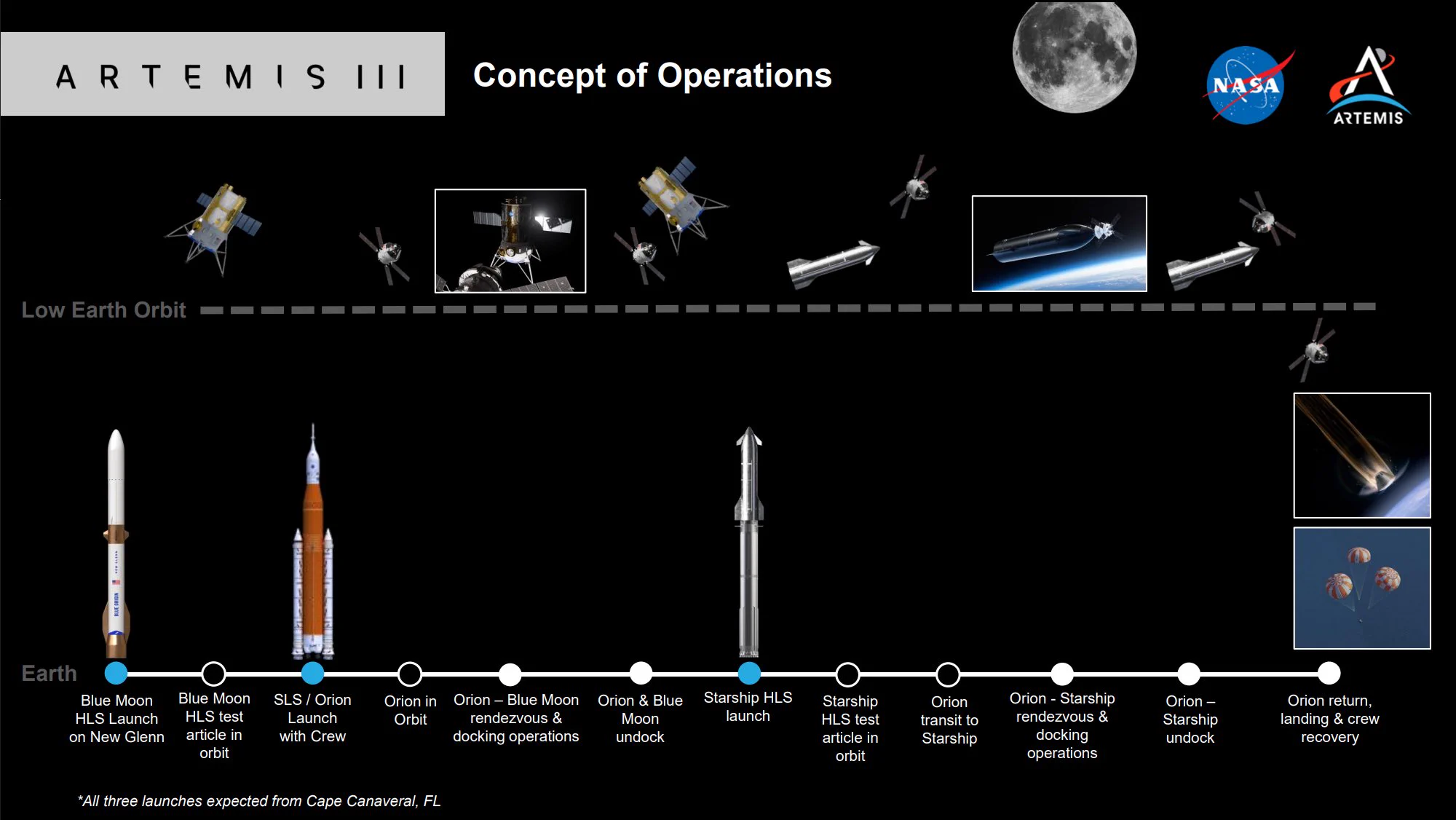
The mission architecture for Artemis III has been defined further. Artemis III will be a 14-17 day Low Earth Orbit docking demonstration meant to test the capabilities of our lunar lander providers before we land on the lunar surface.
After Space Launch System lifts off, Blue Origin’s New Glenn will launch from the Kennedy Space Center and deploy their Blue Moon which can stay up to a month in Low Earth Orbit. During that time period, Blue Moon’s RCS thrusters and life support systems will be tested.
Once Blue Moon is cleared out, NASA's Space Launch System will launch from the Kennedy Space Center and deploy Orion into a highly elliptical orbit (1600x900mi). Then after the first day, the capsule will lower into a 300mi Low Earth Orbit.
First two days will be spent with the crew performing proximity operations with Orion and testing the spacecraft. Then it will lower into an rendezvous orbit (270mi) and prepare for docking. On day 3, Orion will dock with Blue Moon where guidance systems, communications, life support, docking mechanisms, etc. between Orion and Blue Moon will be tested. emergency scenarios will also be tested. This process will take about 2 days.
SpaceX's Starship rocket will launch from Florida to deploy their Human Landing System into Low Earth Orbit. Additionally, Orion will undock from Blue Origin and reduce its orbit to 206mi and dock with Starship on day 8 where the same systems will be tested where they will remain docked for a short 2 hours.
The rest of the mission will focus on crew science demonstrations and experiments such as survival suit evaluations, docking sensor tests, human tests, and science & technology demonstrations.
The Orion crew and Service Module are both at the Kennedy Space Center undergoing installation and testing. Heatshield production is in progress. The Core Stage engines are at teh Stennis Space Center going through testing and the core stage is expected to be ready early 2028.
The Axiom suit has been reduced from 500lb to about 250lb saving weight and reducing complexity which minimizes delays.
There will be two upper stage configuraitons to choose from, the current ICPS which was saved from Artemis III. For Artemis IV the capsule will change to a "stretched" contour stage instead of using an ICPS stage. The Contour Stage is already flown on ULA's Vulcan rocket and could increase Orin's fuel capacity by about 50%.
The crew has participated in 150 hours of classroom instruction and 22 simulations with flight control. Flight control themselves have performed 50 simulations for Artemis III. The launch team at the kennedy Space Center have performed over 100 hours worth of simulations.
Booster stacking was completed at the end of September, 20% faster than booster stacking for Artemis II. The core stage is preparing to be integrated with the boosters. Within the following months, SLS once completed stacking, will roll out of the Vehicle Assembly Building where they will perform additional tests at the launch pad.
Because Artemis III is a LEO docking mission, NASA decided to save their only upper stage (ICPS) for Artemis IV and replace it with a spacer on Artemis III which will be delivered to the Kennedy Space Center in the coming months.
Orion and the Service Module were integrated together and 95% complete where they are undergoing testing. Two extra starlink terminals compared to Artemis II will be added to Orion improving image quality. Over 200 components of the Artemis II spacecraft have been removed and are being reused for this mission.
Blue Origin is recovering from their New Glenn incident* which as temporary cut off their launch capabilities where they plan to resume pad operations in November. The New Glenn booster has been sent to their integration facility. The crew cabin is being built with integration into the lander being planned for early 2027.
*In May, Blue Origin's New Glenn blew up during testing destroying the launch pad and halting the company's launch capabilities. Blue Origin has spent the last 5 months on rebuilding the pad.
Starship performed its 14th test flight late September where it went into orbit for the first time and deployed the first V3 Starlink satellites.Test Flight 15 most likely in November, may feature a catch for both the booster and the ship at the launch pad, two critical components needed for full reusability. HLS design is complete and is planned to start fit checking next month. SpaceX is targeting propellant transfer demonstration early 2027.